A Mystery Without a Detective: Following the Clues Yourself
Some mysteries hand the viewer the work usually assigned to an investigator. Learn how objects, omissions and competing accounts make that invitation satisfying—and how to watch without racing to a verdict.
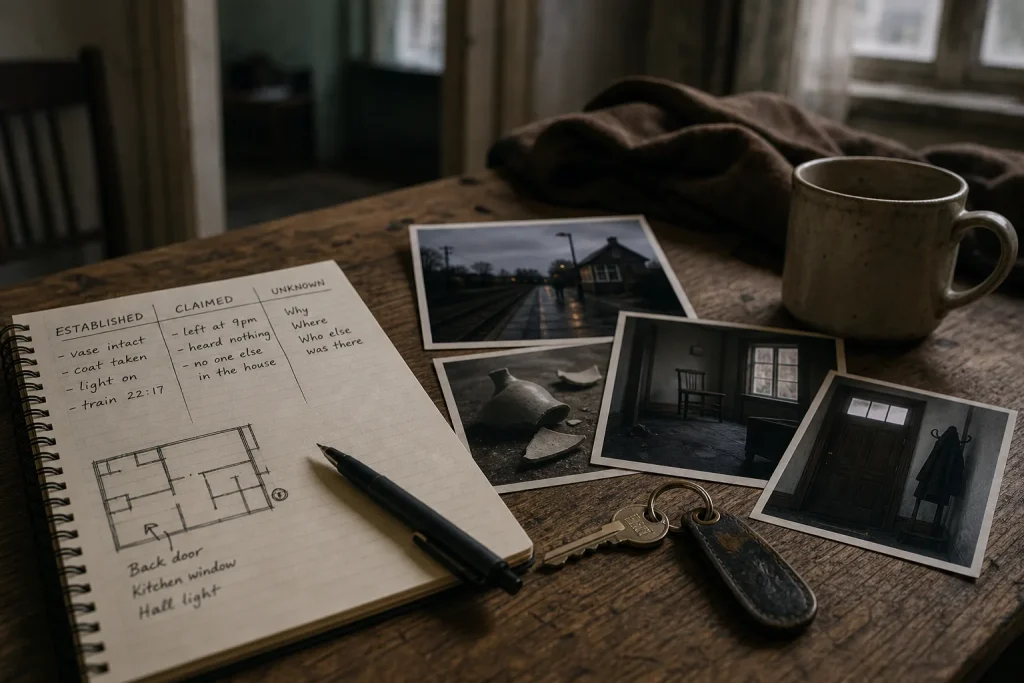
A key left in a locked room can matter more than the person asking questions about it. In mysteries without a conventional detective, the audience often becomes the investigator: noticing what characters overlook, comparing accounts and deciding which details deserve attention. The pleasure lies not only in guessing who did what, but in seeing how the story teaches you to read its world.
Notice what the camera treats as evidence
Without a sleuth to announce that a clue matters, the film or series must guide attention through form. A lingering shot of a muddy shoe, a repeated view of an empty chair or an object placed carefully at the edge of a frame can suggest that something will return. None of these signals proves a particular theory. They tell you to remember.
Pay attention to ordinary things that acquire an unusual emphasis. A cup appears in two scenes, but its position changes. A window is shown from inside and then from the street. A character reaches for a coat before anyone mentions the weather. The detail becomes evidence when it sits uneasily beside what you have been told.
This is a little like sorting a handful of buttons: shape and colour may help, but you still need to decide which ones belong together. Avoid treating every striking image as a code. Ask instead whether the detail connects to a concrete question about time, access, motive or memory.
Compare accounts rather than waiting for an explanation
In a detective story, an investigator may interview witnesses and assemble their statements. Elsewhere, the audience does that work by watching conversations recur from different positions. One character remembers a tense farewell; another describes an ordinary departure. The gap may reveal deception, but it may also show how fear or grief changes what people notice.
Listen for the distinction between an observation and an interpretation. “The hall light was on” is an observation. “Someone was waiting for me” is an explanation. A speaker may be honest about the first and mistaken about the second. Keeping those categories separate prevents a confident character from becoming an automatic source of truth.
When an account changes, ask what changed with it. Did the speaker gain a reason to conceal something? Have they heard another version? Are they correcting a detail, or revising the whole story? Small shifts can be more revealing than a dramatic confession because they show where a person feels exposed.
Use setting to test what could have happened
A house, workplace or small town can function as a map of opportunity. Notice who has keys, which doors can be seen from the kitchen, and whether a sound might carry between rooms. In a story set around a train station, for instance, a timetable and a platform layout can matter as much as anyone’s account of the evening.
Keep physical possibility distinct from motive. A character may have had access to a room without having a reason to enter it. Conversely, a strong motive cannot put someone in two places at once. Setting helps you test the mechanics of a theory before deciding whether its emotional logic fits.
Say you notice that a vase is intact in a scene set after a supposed argument, although another character says it was smashed before they left. If the story has already shown the room clearly, you might mark the mismatch and wait. The expected result is not an instant solution, but a more precise question: is the witness remembering the wrong room, hiding a later visit, or describing events out of order?
Track omissions without assuming every silence is a lie
What a story withholds can direct your attention as firmly as what it shows. A conversation may begin after the crucial exchange; a scene may cut away from a character’s face; a familiar object may vanish between visits. These gaps invite questions, but they are not all clues in the same sense. Some create uncertainty about events; others keep us close to a character’s limited knowledge.
Notice who is allowed to speak and whose account is absent. If a family dispute is described entirely by one relative, the missing perspective matters even before it arrives. If the story never supplies it, that absence may be part of the point: the audience has to judge what can be known, rather than expect every blank to be filled.
A useful habit is to keep a small mental ledger: what is established, what is claimed, and what remains unknown. You need not write anything down. The distinction is enough to stop a suspicion from quietly turning into a fact just because it has been repeated.
Let the answer revise the question
A satisfying reveal does more than identify a culprit. It can change the meaning of an earlier gesture, expose a false assumption or show that the apparent puzzle was built around the wrong question. Perhaps the issue was not who entered the room, but why everyone agreed to say that nobody had.
When an explanation arrives, revisit the clues that seemed important. Do they now fit without requiring you to ignore the story’s established details? A twist may be surprising, but surprise alone does not make it fair. The strongest resolutions make earlier moments newly legible while leaving room for the characters’ motives to remain complicated.
Following the clues yourself does not mean watching with a fixed theory or trying to beat the story to its ending. It means staying alert to the difference between seeing, hearing and inferring. When a mystery gives you no detective, that careful distinction becomes your most reliable tool—and sometimes the story’s most interesting clue is the assumption you brought into the room.